

Thursday saw investors drop the SPX down to the 3700 valuation which was quickly followed by buying. The morning low of 3700 was not seen again and trading turned back to choppiness with the SPX trading primarily between 3725 and 3745 for the remainder of the day. Most investors were sitting on the sidelines ahead of Friday’s jobs numbers.
The SPX dropped 40 points to end the day at 3719 for around a 1% decline. The NASDAQ fell 181 points to end the day at 10,342.
While Friday will be all about the October jobs numbers for the market direction, the technical indicators will still play a role on Friday, especially as the day wears on.
Let’s review the closing technical indicators from Thu Nov 3 2022 to see what to expect for Fri Nov 4 2022.
Stock Market Outlook Chart Comments At The Close on Thu Nov 3 2022
On Thursday the S&P closing candlestick closed at the 21 day moving average and left behind a bounce signal.
The Upper Bollinger Band has turned back down but is above the 50 day and 100 day moving average which is still bullish.
The Lower Bollinger Band is moving sideways rather than up or down. This is neutral which is better for the bulls.
The 21 day moving average is dipping lower which is bearish.
The 50 and 100 day moving averages are still falling but the 200 day is turning sideways. This is bearish.
There are 7 down signals in place since April and no up signals. The chart has switched back to bearish.
The chart is 80% bearish for Friday.
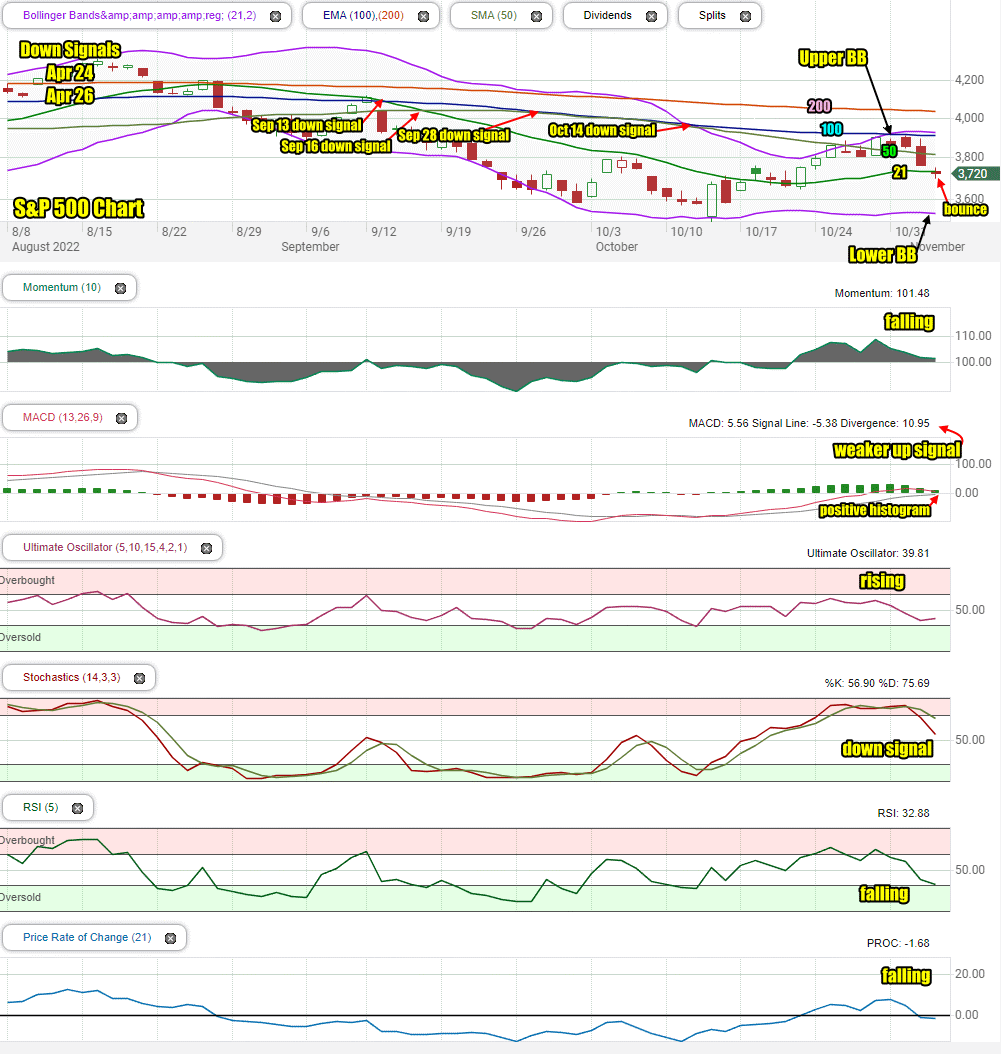
Stock Market Outlook review of Thu Nov 3 2022
Stock Market Outlook: Technical Indicators Review:
Momentum: Momentum is falling and positive.
- Settings: For momentum I use a 10 period when studying market direction.
MACD Histogram: MACD (Moving Averages Convergence / Divergence) issued an up signal on Thursday Oct 16. On Thursday the up signal took a big hit and lost more strength. The histogram also lost more strength.
- Settings: For MACD Histogram, I am using the Fast Points set at 13, Slow Points at 26 and Smoothing at 9.
Ultimate Oscillator: The Ultimate Oscillator is rising and negative.
- Settings: The Ultimate Oscillator settings are: Period 1 is 5, Period 2 is 10, Period 3 is 15, Factor 1 is 4, Factor 2 is 2 and Factor 3 is 1. These are not the default settings but are the settings I use with the S&P 500 chart set for 1 to 3 months.
Slow Stochastic: The Slow Stochastic has a down signal in place and is falling from being overbought.
Settings: For the Slow Stochastic I use the K period of 14 and D period of 3. The Slow Stochastic tries to predict the market direction further out than just one day.
Relative Strength Index: The RSI signal is falling and just above oversold readings. There is plenty of room to fall further.
- Settings: The relative strength index is set for a period of 5 which gives it 5 days of market movement to monitor. It is often the first indicator to show an overbought or oversold signal.
Rate of Change: The rate of change signal is falling and negative.
- Settings: Rate Of Change is set for a 21 period. This indicator looks back 21 days and compares price action from the past to the present. With the Rate Of Change, prices are rising when signals are positive. Conversely, prices are falling when signals are negative. As an advance rises the Rate Of Change signal should also rise higher, otherwise the rally is suspect. A decline should see the Rate Of Change fall into negative signals. The more negative the signals the stronger the decline.
Support and Resistance Levels To Be Aware Of:
4000 is resistance
3975 is resistance
3965 is resistance
3950 is resistance
3925 is resistance
3900 is resistance
3875 is resistance
3850 is resistance
3825 is resistance
3800 is resistance
3775 is light resistance
3750 is light resistance
3730 is light support
3700 is light support
3675 is light support
3650 is light support
Stock Market Outlook for Tomorrow – Fri Nov 4 2022
For Friday the technical signals continue to deteriorate but the closing candlestick is pointing to a potential bounce, especially after the markets held together on Thursday.
The S&P chart is back to being strongly bearish.
The morning will be all about the October non-farm payroll numbers but the afternoon could see some influence from the technical indicators which, while more bearish than they were at the start of the week, are still bullish enough to bounce the market.
A rising unemployment number will bounce stocks from the open. A lower unemployment rate will send stocks lower.
Potential Market Moving Events
The October non-farm payroll report is the second most influential event for this week.
Thursday:
8:30 Weekly Initial Unemployment Insurance Claims came in at 217,000 in-line with the prior week.
8:30 continuing jobless claims was 1.49 million.
8:30 Foreign trade deficit was higher at $73.3 billion.
8:30 Productivity was 0.3%
9:45 S&P US services PMI rose to 47.8 from 46.6
10:00 Factory orders rose 1/10 to 0.3% from 0.2% but still shows the economy is doing well.
Stock Market Outlook Archives
Stock Market Outlook For Wed May 6 2026 – Choppy But Higher Still

Morning Investing Strategy Notes for Tue May 5 2026

Stock Market Outlook For Tue May 5 2026 – Overbought and Lower

Morning Investing Strategy Notes for Mon May 4 2026
Stock Market Outlook For Mon May 4 2026 – Dips Likely With Possible Lower Close
Morning Investing Strategy Notes for Fri May 1 2026
Stock Market Outlook For Fri May 1 2026 – Overbought But Higher

Morning Investing Strategy Notes for Thu Apr 30 2026
Stock Market Outlook For Thu Apr 30 2026 – Dips Likely Possible Lower Close
Morning Investing Strategy Notes for Wed Apr 29 2026
Stock Market Outlook For Wed Apr 29 2026 – Choppy But Higher Ahead Of More Earnings

Morning Investing Strategy Notes for Tue Apr 28 2026
