
Technically stocks are deeply oversold so a bounce was not unexpected. The move by the S&P to retake 1750 and then close above it is important. The market could drift sideways for a few days and still be fine if it held the 1750 level. The problem is that it is questionable until the unemployment numbers are released. That should give the market a clearer direction either up or down. Remembering that this is a bull market correction, it is not uncommon for a correction to bottom and then the market move back up quickly.
Market Direction S&P 500 Daily Chart for Feb 4 2014
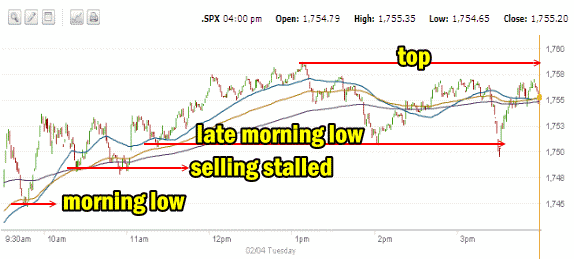
The intraday one minute chart below shows Tuesday’s market direction action. The morning low held and a second rally pushed higher than the first early morning rally. The selling stalled out after that rally and a second rally fell back but also stalled at the same level. This gave investors confidence to do some trading as most were not concerned that the market bottom would fall out for the day. The late morning low however ended up being the low for the afternoon as in the last half hour investors sold down the market. A top around 1:00 PM was put in so while the late afternoon selling did not win out, investors pushed back up in the last half hour but could not recover the 1:00 PM top.. This is understandable as the market direction up was primarily technical in nature and most investors today were simply trading without any interest in holding stocks more than a few hours.
Comparing Recent Market Direction Corrections
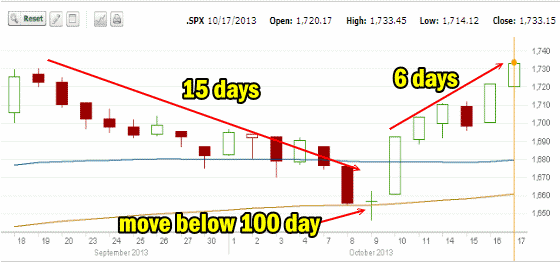
If we look at the last correction in October 2013 we can see that it took 15 days for the market to fall 4.7%. The first move below the 100 day exponential moving average (EMA) found the market pushing back and closing back above the 100 day. That lead to a 6 day rally back which regained the market momentum back up. We know then that a recovery can be quick if investors think a correction is over and the market direction is back up.
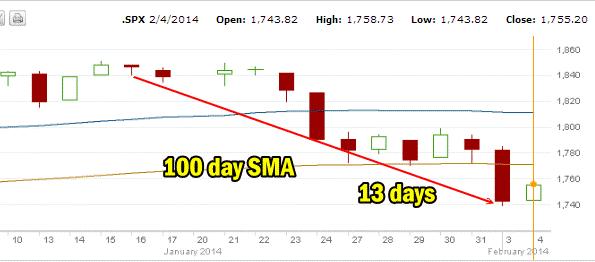
But the October 2013 correction was just 4.7% and no index broke the 200 day moving average. In the present correction, depending on when we select to count from the market pulling back, we could say that the market has corrected over a 13 day period. Technically though we could also say that the market has been in correction mode since Dec 31. At any rate the S&P is back down to below the 100 day moving average. It would not take much for stocks to push back up and close above the 100 day moving average, but the problem is that the Dow broke the 200 day moving average and almost always that break will be revisited at some point during the correction. Therefore the likelihood that this correction is nearing being over is slim. However, if stocks can push back up above the 100 day and then move above 1800, that will signal a resumption of the uptrend. I find that unlikely at this stage of the correction but it is important to understand how fast the market trend can change from down back to up.
Advance Declines For Feb 4 2014
Despite the bounce today only 30 stocks set new highs while 129 set new lows. 66% of stocks were advancing while 31% were declining.
Market Direction Closings For Feb 4 2014
The S&P closed at 1755.20 up 13.31. The Dow closed at 15,445.24 up 72.44. The NASDAQ closed at 4031.52 up 34.56.
The IWM ETF rose just 0.75% to close at $109.47.
Market Direction Technical Indicators At The Close of Feb 4 2014
Let’s review the market direction technical indicators at the close of Feb 4 2014 on the S&P 500 and view the market direction outlook for Feb 5 2014.
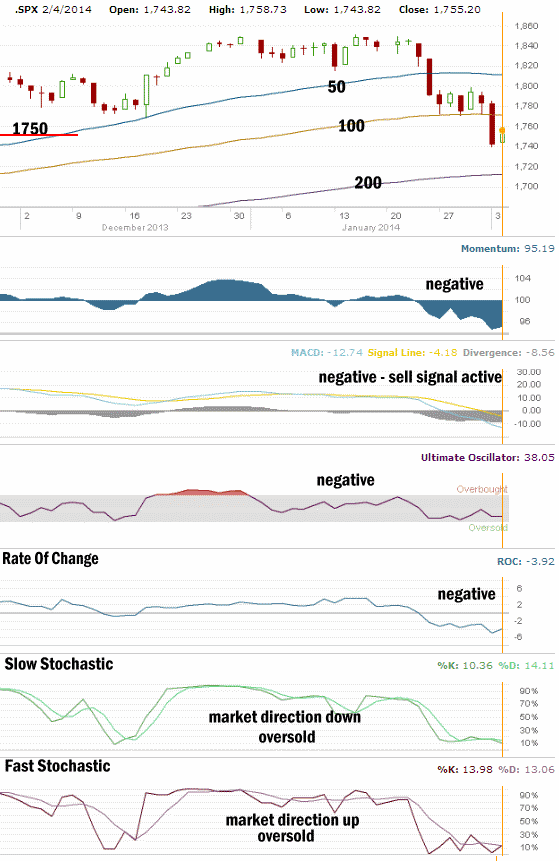
The 1750 level was broken yesterday but recaptured today. The S&P also closed above 1750 which is a good sign but technically the market needs follow through and a higher open and close tomorrow. Meanwhile the Dow closed just at the 200 day but failed to close distinctly above it. This is not a great signal that stocks will recover quickly.
For Momentum I am using the 10 period. Momentum has been the best indicator over the past two months, replacing MACD as the most accurate indicator. Momentum remains strongly negative.
For MACD Histogram I am using the Fast Points set at 13, Slow Points at 26 and Smoothing at 9. MACD (Moving Averages Convergence / Divergence) issued a sell signal on Jan 8 2014 which was confirmed on Jan 9. MACD refused to turn positive since Jan 8. MACD remained strongly negative today and continues to point to more downside action.
The Ultimate Oscillator settings are Period 1 is 5, Period 2 is 10, Period 3 is 15, Factor 1 is 4, Factor 2 is 2 and Factor 3 is 1. These are not the default settings but are the settings I use with the S&P 500 chart set for 1 to 3 months.
The Ultimate Oscillator is negative and remains very oversold despite today’s push back higher.
Rate Of Change is set for a 21 period. The rate of change is still negative and now turning lower. The reading of negative 3.92 is higher than yesterday’s but it is still very negative..
For the Slow Stochastic I use the K period of 14 and D period of 3. The Slow Stochastic is signaling that the market direction is down. It is also oversold..
For the Fast Stochastic I use the K period of 20 and D period of 5. These are not default settings but settings I set for the 1 to 3 month S&P 500 chart when it is set for daily. The Fast Stochastic is indicating that the market direction is up for Wednesday and it is also oversold.
Market Direction Outlook And Strategy for Feb 5 2014
The Dow closed at or just below the 200 day exponential moving average (EMA). This remains negative for stocks in general. There is not a lot to say about today. It was a technical bounce and not much more. It was nice to see the S&P recapture support at 1750 but it could easily break with more selling. For tomorrow all the indicators but one are signaling that stocks will move lower tomorrow. However the market remains oversold and it would not be surprising to see the market move higher tomorrow before it sells lower.
Market Direction Internal Links
Profiting From Understanding Market Direction (Articles Index)
Understanding Short-Term Signals
Market Direction Portfolio Trades (Members)
Market Direction External Links
Market Direction IWM ETF Russell 2000 Fund Info
Market Direction SPY ETF 500 Fund Info