
The market direction outlook for Monday was for stocks to trend sideways but have a bias higher. In my morning comments I discussed the market condition and noted that a morning low was put in and from there stocks had begun to climb. Let’s take a look at the market action for Monday in the Dow first and then the S&P.
Dow Market Direction For Feb 10 2014
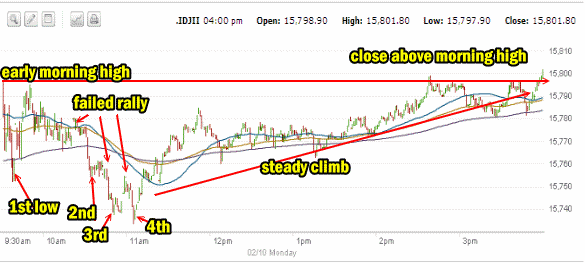
Looking at the 1 minute intraday chart for Feb 10, we can see that a high was put in early in the morning. Following the opening high the market pulled back and made the first low of the day. From there a rally commenced which reached to the early morning high but failed to break through. This brought in sellers and another rallied commenced which failed to move very high at all. Again sellers emerged and they pushed the market to a 2nd low but it was still higher than the early morning low. This started another failed rally which they collapsed to a 3rd low which was a new low for the day. Another rally was attempted and again failed. This brought in a fourth pullback and a new lower low. This seemed to give investors confidence. Each of the lows was not worrisome and the volumes were low on the selling. Investors spent the rest of the day pushing the market back up and finally the Dow closed just above the early morning high.
The close today still puts the Dow right below the 100 day exponential moving average (EMA).
S&P Market Direction for Feb 10 2014
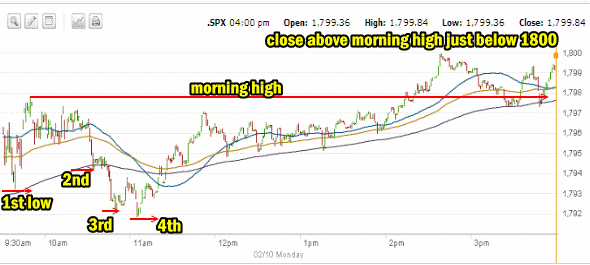
The S&P followed much of the same pattern as the Dow but was much stronger. The morning saw many of the same movements but the morning high was set after 9:30. There were four lows during the morning but the afternoon saw a quick rally through the lunch hour and then a sideways movement until around 2:30 when the market shots up to 1799.94 or basically almost breaking the 1800 level. From there the market direction pulled back a bit below the morning high and then pushed right back into the close. The close at 1799.84 sets the S&P up to break 1800 tomorrow.
Advance Declines For Feb 10 2014
Momentum to the upside was not as strong today which is a bit of concern. 57% of stocks were advancing and 40% were declining. 73 new highs were made and 77 new lows. Still, momentum is on the upside and today’s weakness was to be expected after such a good showing late last week.
Market Direction Closings For Feb 10 2014
The S&P closed at 1799.84 up 2.82. The Dow closed at 15,801.79 up 7.71. The NASDAQ closed at 4148.17 up 22.31.
The IWM ETF closed up $0.29 to $111.04
Market Direction Technical Indicators At The Close of Feb 10 2014
Let’s review the market direction technical indicators at the close of Feb 10 2014 on the S&P 500 and view the market direction outlook for Feb 11 2014.
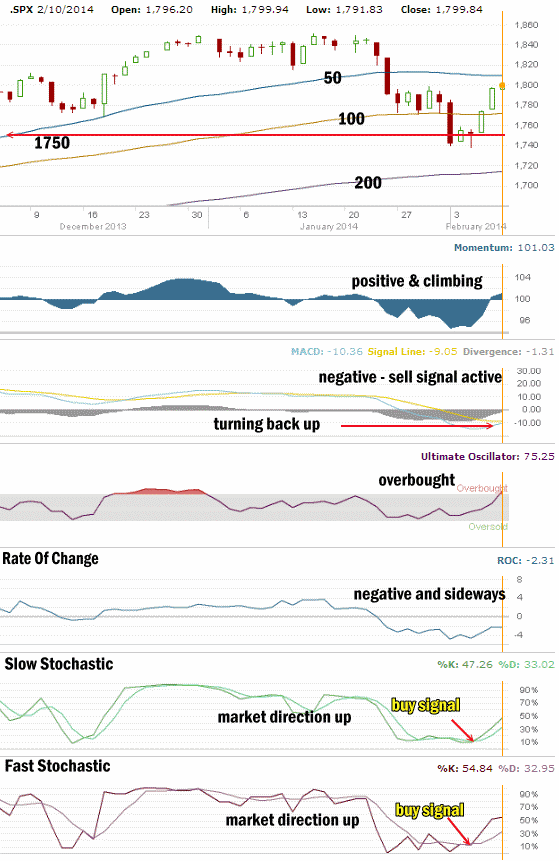
The 1750 level is holding the S&P up. With the S&P now ready to break back above 1800, the 1750 level looks like it remains strongly in play here. This means that shortly we can expect the S&P to begin to build support levels above 1750. This is good news for the market direction up.
For Momentum I am using the 10 period. Momentum has been the best indicator over the past two months, replacing MACD as the most accurate indicator. Momentum is now back positive and is continuing to climb.
For MACD Histogram I am using the Fast Points set at 13, Slow Points at 26 and Smoothing at 9. MACD (Moving Averages Convergence / Divergence) issued a sell signal on Jan 8 2014 which was confirmed on Jan 9. MACD refused to turn positive since Jan 8. MACD today is still providing a negative signal but at negative 1.31, it has really pulled up nicely and if you look at the signals you can see that it is getting ready to move from negative to positive which will issue a buy signal.
The Ultimate Oscillator settings are Period 1 is 5, Period 2 is 10, Period 3 is 15, Factor 1 is 4, Factor 2 is 2 and Factor 3 is 1. These are not the default settings but are the settings I use with the S&P 500 chart set for 1 to 3 months.
The Ultimate Oscillator is back overbought. As incredible as it may seem, the past two days of large up moves coupled with today’s market strength has pushed the Ultimate Oscillator into overbought territory. This does not mean the S&P has to pull back, but it does signal that a cautionary stance is warranted as we could see more weakness for the next several days.
Rate Of Change is set for a 21 period. The rate of change is still negative and is trending sideways. This shows that the rally back while good, is primarily being traded against and long-term investors are not adding to their positions here.
For the Slow Stochastic I use the K period of 14 and D period of 3. The Slow Stochastic is signaling again today that the market direction is up and it issued a buy on Thursday.
For the Fast Stochastic I use the K period of 20 and D period of 5. These are not default settings but settings I set for the 1 to 3 month S&P 500 chart when it is set for daily. The Fast Stochastic is also indicating that the market direction is up for the fourth day and it also issued a buy signal on Feb 6 which helps to confirm the buy signal from the Slow Stochastic.
Market Direction Outlook And Strategy for Feb 11 2014
Momentum definitely slowed today but there are enough signals to advise that the market direction should continue higher on Tuesday. The testimony of Fed chairman Janet Yellen could move the markets one way or the other but in general, whatever happens with regards to her comments will be forgotten within a couple of days. The market direction technical indicators are pointing to higher prices. The Dow looks like to wants to break through the 100 day EMA and the S&P is poised at the doorstep of 1800.
My strategy remains the same. I have closed any covered calls on stock that I do not want to be exercised away from. I am still putting money to work in selling puts. For Tuesday the outlook is for stocks to stay weak but the bias at present is for stocks to move higher again on Tuesday.
Market Direction Internal Links
Profiting From Understanding Market Direction (Articles Index)
Understanding Short-Term Signals
Market Direction Portfolio Trades (Members)
Market Direction External Links
Market Direction IWM ETF Russell 2000 Fund Info
Market Direction SPY ETF 500 Fund Info